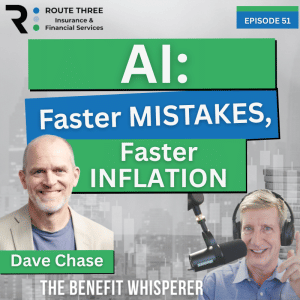
Healthcare isn’t broken, it’s optimized to extract.
In this episode of The Benefit Whisperer, Ralph Weber sits down with Dave Chase to expose what’s really happening behind employer-sponsored healthcare.
From hidden contract clauses to billion-dollar middlemen, this conversation pulls back the curtain on a system that rewards complexity, not outcomes.
They cover:
- Why AI could accelerate bad decisions in healthcare
- How billing games turn millions into tens of millions
- The role of middlemen—and why they keep winning
- What employer-led models could look like instead
If you’re an employer, CFO, or HR leader, this isn’t theoretical. This is your money.
Subscribe for more conversations that challenge how healthcare actually works.
Ralph Weber Host, The Benefit Whisperer: Schedule a FREE Consultation
🌐 https://mybenefitssuck.com
📧ralph@thebenefitwhisperer.com
Special Guest: Dave Chase
https://www.linkedin.com/in/chasedave/
[00:00:00] This episode of The Benefit Whisperer is brought to you by Route 3 Insurance and Financial Services, where smarter benefits begin. If you're tired of rising healthcare costs and opaque insurance contracts, Route 3 is here to help you take control. They specialize in transparent, employer-driven benefit strategies that protect your people and your bottom line. Ready to break away from the status quo? Visit www.fixmybenefitsnow.com and discover how Route 3 can help you build a plan that actually will help you take control.
[00:00:30] For your team and for your budget. So we have exposed a lot of the contracts, the middlemen, the hidden rules that are draining employers' plans. AI is accelerating billing pressures, denials, repricing, stop-loss instability. Dave's bigger point is maybe the question isn't corporate control or more government control. Maybe it's whether employers and communities can take back ownership. Dave, it's great to have you back again.
[00:00:59] Your third time. This is great. Last time we talked about hidden contracts, bad incentives, employers not really having control. What feels different to you right now? Well, I mean, there's a few things that are different. One is the generational shift is a big one.
[00:01:17] Where you have millennials are the largest generation in history and they're in their mid-40s now. And then, you know, we'll probably talk more about AI. What has happened in AI and healthcare?
[00:01:31] What's getting the headlines is kind of sexy stuff. It'll help with diagnosis or do this with, you know, imaging. And, you know, I'm all for positive examples. But the reality is the venture capital that is going into healthcare is all around AI.
[00:01:47] And where it's deploying at scale is all about billing. And it is having a really dramatic negative effect on the spending. And people aren't realizing just how deep the scope is other than they see, why is it these some of the largest stop-loss areas in the world are exiting the market?
[00:02:11] Right. That's, they're used to, I mean, by definition, they're used to shock events. But when their actuarial models don't work, you know, then they exit. And so there's some big things going on there. But those would be two top of mine, this kind of generational shift. And the, you know, and there's a lot of ripple effects of that. But then this AI dynamic, just turbocharging a pre-existing condition.
[00:02:39] Right. And that's a good way to put it. Now we're going to fix it. Okay. We're going to try to fix it. But, you know, the thing is, I've said that putting AI on top of a broken system just really accelerates the breakdown.
[00:02:54] And an analogy that you and I have used offline. It's like strapping a jet engine on top of a Ford Pinto with Firestone 500 tires, you know, like, yeah, it makes it go faster, but it just makes that pothole closer and the eventual explosion.
[00:03:10] So I see it doing just that episodically, that you're quantifying. So, you know, absolutely correct. And you're right. I mean, yeah, venture capital wants to see new technology. I think that technology is needed in healthcare. But until we fix the foundation, I think putting AI on top of it is just going to accelerate the crumble. That's my view.
[00:03:39] Do you agree that AI can really make a bad system even worse? Or actually, let me rephrase that. Can it make a bad system better and more efficient at doing the wrong things? Yes. And that's true of tech, period. I mean, I think the first thing I learned as a new consultant fresh out of school was, you know, don't automate a broken process. Don't throw tech on top of a broken process. And healthcare is riddled with both.
[00:04:07] And so it can hold great promise. And I actually gave a lecture to an upper level law class at a law school recently and talked about kind of purpose driven AI and how it can do wonderful things.
[00:04:24] And that's the potential. And we're definitely doing that in our work. But the reality on the ground is you have dynamics that are just crazy, you know, like 26.7% compound year over year increases in claims over $2 million.
[00:04:42] Wow. Blue Health Intelligence published the first insured data linking AI to billing inflation. That's the intelligence arm for the whole Blue Cross Blue Shield network. And they found that postpartum hemorrhage diagnoses at high AI hospitals surged from 4% to 12.3% while transfusion rates stayed flat. So it's just coding, right, without the actual clinical change and
[00:05:12] And you have a lot of those types of examples out there now. Right. If you have access to the data and you're really watching what's going on, but unfortunately, most aren't and they're paying the price. Yeah, no, exactly. That's a great point, Dave. I had Mark Cuban and Kevin Shulman on an episode that just aired the other day. And we were talking about just that. I mean, the AI battles, the arms race, where, you know, they're using it to increase
[00:05:42] profit. My view is that if the hospitals receive what they were supposed to and quicker, there wouldn't be a need for that. You know, the problem that I see is that they're not actualizing what they're supposed to. Hence, you know, there's what I call the sort of uncertainty premium that they kind of build in. And denials going back and forth is crazy, but the American people are suffering at the end of the day.
[00:06:08] Yeah. Well, and it's an arms race between the big health systems and the big carriers and the employers and the rest of us are paying for both sides of that. Right. And it's really dramatic what's happening. Like you said, just the denials, you know, so-called medical denials are like for a second or some crazy stats like that, that obviously no human weighed in on. Right.
[00:06:31] And we see that, I mean, it's a lot like hackers, right? They constantly do probes to find weaknesses in a network and how to attack it. And it's happening on both sides. And the carriers have all these schemes. One that's in the public record, you know, it's particularly big and they're not all this big. There's just as many or there's just tons of them that are smaller that add up to this.
[00:06:57] But, you know, it was a inpatient site case where the build charges were, I think, 996,000. And the carrier jacked up the so-called build charges to $11 million and then, quote unquote, saved in air quotes, you know, $7 million.
[00:07:21] So that at the end of the day, the employer paid over $4 million. The carrier was Cigna. They made $2.5 million. Their partner in that was Multiplan. It's now called Claritev. Made like $670,000.
[00:07:39] The provider made like, I think it was $870,000 or something like that. And so way more of the dollars were going to intermediaries than the actual care providers. At the end of the day, right, it was the employer who picked up the tab. They paid $4 million for less than a million dollar in charges. And who knows whether all those charges were legit? Right, right.
[00:08:07] Even if it's assumed they were, that's still a crazy multiple. Yeah, that is a crazy multiple. Unfortunately, you know, that happens way too much. Probably, I mean, way more than you and I realize. Luckily, we're catching some of them. But, you know, I'm sure there's way more. And the variance is huge. Now, how about the, you know, the clause that a lot of TPAs, and when I say TPA, I include the BUCAs.
[00:08:32] Blue Cross, United, Cignet, Humana, etc. A lot of them have a clause in their administrative services agreement that says, if we catch a mistake, we're going to keep 30% of it. We're going to, you know, charge you 30% and give you back 70%. So, taking that, you know, like that $7 million, right, for example, that you just said, you know, 30% of that is $2.1.
[00:08:58] So, they could say, hey, you know, $2.1 million for us catching this $7 million, right, for example. Was that part of those numbers that you talked about? Yeah. Oh, absolutely. That was exactly it. You know, it's like the bank, you know, you deposit your money in the bank, and then they let the bank get robbed, take your money.
[00:09:18] And then they're like, oh, we actually got some of it back after we let the bank get robbed, and we're going to take 30%, 40% of the take on getting it back. I mean, you can't make this stuff up. That's why I go with publicly, public record stuff like that TML recovery versus Cigna case. Yeah, yeah. Wow. That's crazy. It's also in the congressional record, by the way, too.
[00:09:42] Well, that's good. That's good. So, with this AI, what are you seeing? Are you seeing, like, is it basically billing intensity, harder denials? You know, is it repricing? And what can employers do about this? Yeah. Unfortunately, it's all of the above.
[00:10:00] If they can think of it, and there's some very creative people in Silicon Valley and at these companies, there's been $20 billion of venture capital that's gone in just into revenue cycle and AI and healthcare. Wow. Which is, you know, what basically jacks up bills. Mm-hmm. It's all of the above. Right.
[00:10:22] In terms of what you can do about it as an employer is, first of all, something that you should already be doing. And it's not always easy, but it is your legal duty under the ERISA fiduciary to get access to your claims data and to know what to do with it. Right. And so, you can start to see these anomalous things. Ideally, you're having clauses in that allow for pre-adjudication payment integrity.
[00:10:52] So, you can see at these things, like what I mentioned, when there's this disconnect between what's being billed and what's actually happening on the ground. And you see all of a sudden the rates of particular types of charges are going up 6X in one year, like unless there's some, you know, really unusual pandemic or something that's driving billing changes. Like it's obvious that something's happening.
[00:11:16] And that's what we see over and over is the employers that are the ones that are spending literally 40, 50% less per capita with the best health plans in America. They have access to their data. They know what to do with it. They're following what's going on, looking at any, really all the claims, but certainly any meaningful dollar amount. And they don't have... Everybody agrees from both sides that, you know, ultimately we want to have affordable healthcare that's accessible. Yeah.
[00:11:44] You know, and we don't want to bankrupt people from their deductibles and out of pocket. So, and the other thing, tool insurance companies. What was the first one? It was like Forrester's or something like that. I forget what it was right now, but it was something like that. And it worked. You know, when the first health plan, prepaid healthcare started 1926, 100 years ago in Dallas, it was the Baylor teachers prepaid health plan.
[00:12:13] But it's important to study the history, okay? Not to point fingers, but to learn. What have we done wrong? What have we done right? What's worked? Let's keep doing that. What has failed? Let's do less of that. And trying that. I love your idea. We've got to try different things because what we're doing now is not working. Yeah.
[00:12:37] And, well, it's important to also realize it took me a while to sort of connect the dots on this. On like, why is this so politicized? And you're like, I have friends and family all over the political spectrum. You actually get down to it. Like you said, people are largely in agreement. But then you realize there is no better way to freeze the status quo on anything than to politicize it, right? Get people into their trenches. Yeah. Chin up some controversy.
[00:13:06] And both sides have done it, you know, pretty well. Yeah. I'm not a partisan. We're not a partisan group. Right. And, you know, when I'm maybe a bit cynical, I'll say, you know, in D.C., there's about 10% who are true conservatives and about 10% who are true progressives. 80% are preservatives. They're just there to preserve the status quo.
[00:13:31] And so that's where the voice of the voter leads the way and the electeds will follow. And that's where, you know, if you study revolutions and social movements, that's the way it goes, right? There's a grassroots, bottom-up movement. And eventually the politicians will want to run to the front of the parade. But the cavalry is not coming from D.C. to fix this. It's on us.
[00:13:59] And then, sure, there's some things that could be done to accelerate the replication of that, like what happened, you know, in the 30s with the rural electrification. But it still was up to the community to step up and do these things. Of course, there were people and companies that had, you know, power lines, you know, poles to put up and the lines and the transformers and all that. And so there's, like, plenty of free market opportunity around that.
[00:14:26] But the core, like these core needs that we have, energy, healthcare, I really believe that they need to be owned by the community that receives the service. And remember that only 10% or 20% of health outcomes actually come from sick care. It's 80% to 90% that are the other things. And health starts at home, like with mom and dad, and then fans out from there.
[00:14:55] And we'd sometimes think it's like, oh, it's a prescription or it's something in the hospital or it's at the state capitol or D.C. No, like it's mom and dad. And the further it goes away from home, the more likely it is to go off the rails. And it's that district scale that we've seen in other areas, right? We have water districts, fire districts, school districts, congressional districts, you know, mosquito abatement districts, right?
[00:15:20] That we have these local bodies that are generally have a level of accountability that doesn't exist when you're distant. On the other hand, it's also not fair to put on a primary care doc, hey, you've got less than an hour a year with a patient, solve all society's problems in, you know, 45 minutes or less. That's unrealistic.
[00:16:12] Governed at that much more local scale. And there's that. The reality is what Wichita needs is different than what Chicago needs, which is different than what Moses Lake Washington needs. And you get at that right scale, they can tailor it and say, yeah, we really need to address early childhood education or we've got an opioid issue, right? They're the ones who are best able to allocate the resources. Again, have some general national framework.
[00:16:41] Certainly the electric utilities plug into the interchange and the, you know, electrical grid that go across state lines and all that kind of stuff. That's all good. I mean, same with our departments. I was a city councilman, right? Our department spent 99% of its time, you know, preventing fires. And then we had a wildfire, right? They got quickly overwhelmed, called in regional, called in state, eventually feds. That rarely happens, but that's great.
[00:17:09] You know, have that when we need it. But the vast majority of time, you don't need all that mess of stuff that's far away from you. Sure. Sure. Makes sense. So let me have you clarify this. So are you talking, like when you're talking about sort of a community health plan, are you talking about the financing layer or who owns the hospital and employs the doctor? Yeah. Financing layer. Right. So it's separate is who owns the hospital and the doctors.
[00:17:38] I mean, I think the doctors, you know, if they want to co-operatize, that's fine. They can do that. What I see more likely is they might put together a network of kind of contracts for their services. And you have in some locales, you've got public hospital districts. I happen to think that separate from this whole cooperative for the health plan, I think that hospitals are the fire department of our health.
[00:18:04] And I think that having our hospital CEOs being treated like their hotel general managers where they're rewarded to fill beds is ridiculously absurd and wasteful. And so I think they should be governed like we govern fire districts. But that's separate from the communal health plan. Sure. Sure.
[00:18:22] And I agree sort of, you know, from a numbers perspective, if you've got 100 beds and 40 of them are filled with contracts that just aren't working for you, close 40 beds, keep 60 open and do well. I mean, that's just my opinion. But very, very interesting, Dave, to simplify so that the listeners can understand in your definition,
[00:18:48] what is the difference between a traditional single employer plan and a community-owned model? Yeah. The difference is they have some shared approaches and shared infrastructure, but it actually starts with them. And that's sort of a key part of our theory of change is you have individual employers making independent decisions, but they're all on the same chassis.
[00:19:14] And then over time, as more come on board, if they want to cooperatize, you know, one way of doing it is like captive captives where there's a particular layer of insurance that they may share. But they may actually say, hey, let's just put this together. Like I'm a manufacturer. I really don't want to be in the health plan business. And so if there's a pathway where they still have a stake in that health plan and a governance voice in that, but they can not have to worry about the day-to-day, like that's the long term.
[00:19:45] But step by step, they have the same direct primary care, same drug coverage, same contracts with hospitals and imaging centers, same stop loss. So there's a lot of efficiencies that they gain and kind of buying power even while not having any new legal entities set up yet. And then over time, let's say you get 5,000, 10,000 lives and they've managed it well for several years.
[00:20:14] Then I think you really have de-risked that becoming kind of a independent insurance entity. And so I think that's how these things can get cooperatized. And if they want to, again, they don't have to. They can stay independent. But if they want to join that and I think these multi-stakeholder cooperatives where like in the health care example would be the patients or citizens, it would be the doctors, it would be the employers.
[00:20:43] And I think that's actually where we have some good, important thinking is like what is the right level of governance and how do you set that as permanent civic infrastructure? Like you don't think about private equity taking it. And I think that's how we sort of bridge from where we're at to that. And then you have interoperability. It's like credit unions, right? You have all these credit unions. It's a form of a cooperative.
[00:21:09] Well, they participate in the ATM networks and, you know, you go to another town, there's reciprocity between the credit unions. And you could have the same thing here where maybe there's just the general umbrella that kind of covers the outer network. But then there's some reciprocity between some of these. And again, there's stuff to get figured out.
[00:21:32] But 99% of the time, you're going to be in your own community getting care there and with people who are locally accountable and have a real stake. I mean, one of the things we're working on right now is where they're really supporting cooperatives and employee ownership. And it's like, hey, up front, why don't we all agree?
[00:21:55] If we do this really well, one of the areas, another area that is really a challenge for most families is the cost of child care, elder care, disability care, and like respite care. Maybe you're an adult caregiver where we say, hey, if we do like these thousands of plans that have happened within Health Rosetta where it's you're saving 20, 40, even almost 60% per capita. We're saying if we do that, we're all in this together.
[00:22:24] That's kind of where the cooperative is. We're going to fund home care. We're going to fund child care. And you've seen individual employers do that, which is wonderful. But I think some of that is another part of common civic infrastructure that we are putting a lot of stress on families and costs there.
[00:22:44] And even in countries where they have relatively well-functioning national health care systems like Italy or South Korea, that social care, that elder care, disability care, child care isn't really addressed that well. And that's where you've seen the rise of cooperatives and these multi-stakeholder cooperatives like a child care. It's like the parents and the workers. The, you know, home care, it's the home care people, the patients, the families, maybe there's some other entity.
[00:23:11] I think we need to really see what's worked and then sort of smartly adapt that to our particular unique situations. Right. You mentioned a lot of examples. Is there any one in particular or maybe another example that, like, in the real world has shown that this can work? I mean, the electrical utilities, I think, you know, for example. But is there anything – have you seen anything in health care that's similar?
[00:23:40] Maybe not even in the U.S., maybe somewhere else. Yeah, yeah. Well, some of these ones that are health care adjacent I just mentioned. But in terms of health care, Brazil has really large cooperatives around this. But let's just stick to the U.S. I mentioned the one in Wisconsin. I think there's another one in Wisconsin or Minnesota that's bigger. It's been around group health somewhere. There was a group health in Seattle that Kaiser acquired. So there's some of those.
[00:24:09] But then there's these ones that are not necessarily a cooperative structure. But in terms of, in my mind, being a community-owned health plan, you look at what the folks in the Alaska Native peoples have done in South Central Alaska. And it's been in place 20 years, some of the – you know, really one of the most amazing turnarounds in probably health care history, certainly U.S. health care history.
[00:24:36] Like worst outcomes, you know, back in the 90s, really a pretty miserable scenario. Lots of disease burden for the Alaska Native people. And it was, you know, at that point, I think it was 65,000 people spread over the area as big as Sweden. And then you fast forward to today, they call their patients or their members customer owners. And they take that to the extreme.
[00:25:00] They are in the, at worst, 75th percentile after being in the 5th percentile in terms of outcomes. In many cases, they're 90th percentile. Many cases are the best health care system in the world. People from Singapore to Sweden come and visit as well as Americans. In fact, we're the CEO of that organization. It's called South Central Foundation. Their care model is called the NUCCA model.
[00:25:25] We're recognizing them at Rosetta Fest, which is our event, that we get together annually. What they've done just is absolutely mind-blowing. And the fact that every American doesn't know about that or doesn't know about rows and hotels says a lot about our health care system and where our priorities are. Because there's nobody in the world who wouldn't want what they have achieved.
[00:25:49] And I guarantee you, there's not a place in America that's got a bigger challenge than the Alaska Native peoples. I mean, they, as I mentioned, they're spread over 65,000. Right. Maybe 70,000 over the size of Sweden. Sweden. And they've got one of the stories the CEO shared was, you know, they wanted to get the women on. They'd go out onto the Aleutian chain and they're on islands. And they're like, hey, we really need to get these women in for, you know, mammographies.
[00:26:18] They said, and they're like, wanted to come in, you know, in October before, you know, the weather really got rough. And a lot of times flights are canceled. And the women, they're like, ain't happening. You may think moose season, you know, is over, but that's when the real work starts for us. And by February, we're really bored. And I come. And I'm like, okay, we'll do it. Who knew moose season could affect health outcomes? But that's the way they listen to their members.
[00:26:47] They adjust. And they have so many stories like that. And it's just remarkable what they've achieved. And it really is that customer ownership, as they call it. Right. Right. Okay. Excellent. So where does Health Rosetta and Nautilus fit into this? Yeah. Yeah. Great question. What Health Rosetta does, maybe I'll start with Nautilus.
[00:27:11] Nautilus is actually setting kind of standards for how to actually do these things. We helped inform them originally and contributed $4 million of intellectual property into Nautilus. But it's an independent entity because what we're doing as a group, you're a big part of this. We're establishing this new health care economy. It's approaching about $100 billion already. Like, it is not a small thing. Right.
[00:27:39] And any time you do that, you need to establish new standards, right? Whether it's, you know, railroads need particular lines or computers to interoperate or, you know, EV charging infrastructure, whatever it might be. Those standards do that. So Nautilus has done that and continues to do that. And, you know, we were talking about AI earlier. It's really, it's taking these, this decade of experience and hundreds of contracts and the smartest people on top of their game and codified in AI.
[00:28:08] So literally you can upload a PBM contract and it will score it almost instantaneously. We call this important work. So that's kind of Nautilus side of it. And then Health Rosetta is actually kind of the activation of that, right? It's actually getting in there with advisors, with employers to build out these plans and operate them on a day-to-day basis.
[00:28:30] So there's a lot of capabilities around setting up the contracts, managing the compliance, managing the data, ultimately taking on the fiduciary responsibility. Right. And just making sure these operate day-to-day while adhering to these standards that Nautilus is putting out there. Excellent. Well, Dave, as always, it's great to have you.
[00:28:54] If people want to follow you, find out more what you're doing, Rosetta Fest, et cetera, how can they reach out to you and find out more? Yeah. I mean, rosettafest.org for Rosetta Fest. And it's open, right? That's something we did a few years ago because this is a team sport, right? We need folks like you, the solutions out there. We need the employers. We need all the benefit professionals. We need the clinical side.
[00:29:19] And when we gathered, I think the last time before we opened it up was 2022. And we had a couple hundred people. We're expecting about 1,500. And it's pretty evenly split between those folks because we're all in this together. And then we have NautilusHealth.org is where the standards are. And if you go to, say, like, NautilusHealth.org slash PBM, you can see the resources there.
[00:29:49] And then there's HealthRosetta.org. And if you go to HealthRosetta.org slash friends, that's where you can download my book for free and get caught up today. We love people who want to get stuff done. There's lots of talkers or the walkers, you know, that are actually making it happen. So hopefully people engage one way or another. We have a lot of stuff that's free. And then we try to keep things as cost effective as possible, you know, where we have hard costs to pick up. Right, right. Excellent.
[00:30:19] Excellent. Great. Well, Dave, you know, again, thanks for being on another exciting episode of the Benefit Whisper. And we will keep the conversation going. This has been an episode of the Benefit Whisper. And if this podcast has been informative, please share it with an employer, CFO, Charo, that can benefit from it. Thanks again, Dave, for being here. Thanks for having me.